
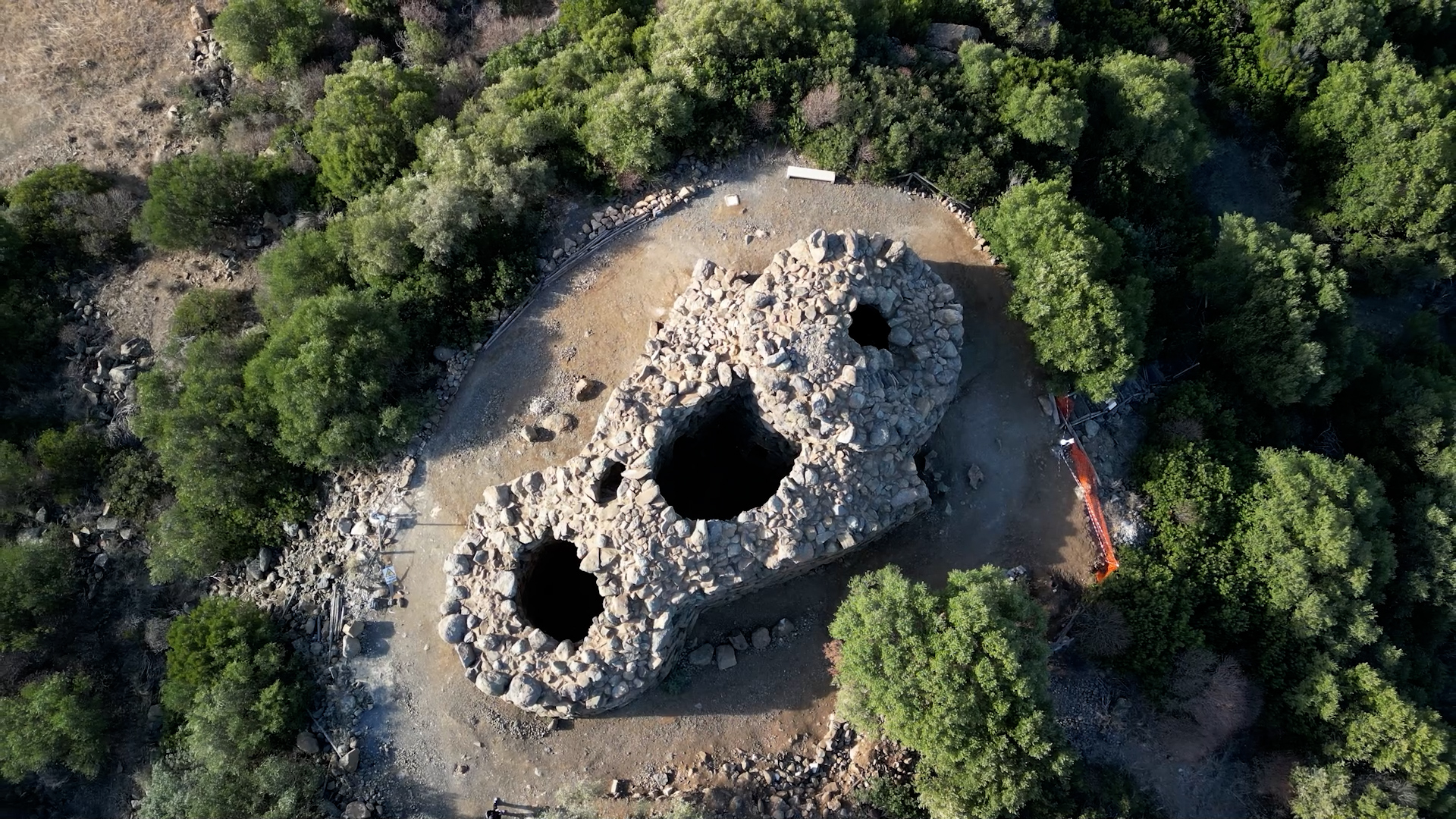
Sa Domu e S’Orcu Nuraghe
Sa Domu e S’Orcu is a particularly striking Nuragic complex because it is located right next to one of the beaches of Costa Rei – Santa Giusta, built on a small hill 58 meters above sea level. At the moment, the nuraghe is largely buried by vegetation and was, until recently, in a state of total neglect. The driving force of Mayor Murgioni and the volunteers aims to set a new course for studies on the site, with the conviction that the nuraghe, once cleaned up and properly restored, could prove to be one of the most evocative on the island, with that view of the sea suggesting ancient architectural wisdom. It is not the only treasure inherited from the past. In fact, Castiadas has a territory that is still waiting to be fully discovered from an archaeological point of view, which could become another tourist attraction alongside the splendor of its coasts.
The structure of the Sa Domu e S’Orcu nuraghe
“Sa Domu e S’Orcu” is a construction that could lead to new discoveries and knowledge about the ancient history of the Sardinians and Sardinia. It is perhaps one of the few, in fact, that faces the sea. Its architecture is very complex: the building was accessible from the southwest side where there is a 3-meter-long corridor. It consists of a bilobate keep (two main towers connected to each other) erected on the highest part of the hill, incorporating the rocky outcrops on which they were built. The two towers, semi-circular in shape, have a diameter of about 7.50 meters, a thickness of over 1 meter, and a remaining height of 3.10 ~ 3.5 meters. They are made of large boulders at the base, roughly worked but precisely placed, which become smaller and better finished towards the top. The main keep is enclosed by an outer curtain wall and a wall that includes 5 secondary towers, which are no longer visible today. The internal wall sections are imposing, consisting of regular rows about 4 meters high and 10 meters long; they connect the two main towers on the northwest and northeast sides. Completing the curtain wall, we find a regular 15-meter wall of well-squared, large blocks, which joins both the rock structures and the two main towers, closing off the southeast side of the Nuragic complex. The collapses make it impossible to identify internal structures, allowing only the observation of some narrow rectangular loopholes about 20 cm wide in the towers. Outside the outer wall, a few meters away on the western side, there are two large circular structures separate from the rest of the construction; these are thought to be enclosures or the bases of huts.

